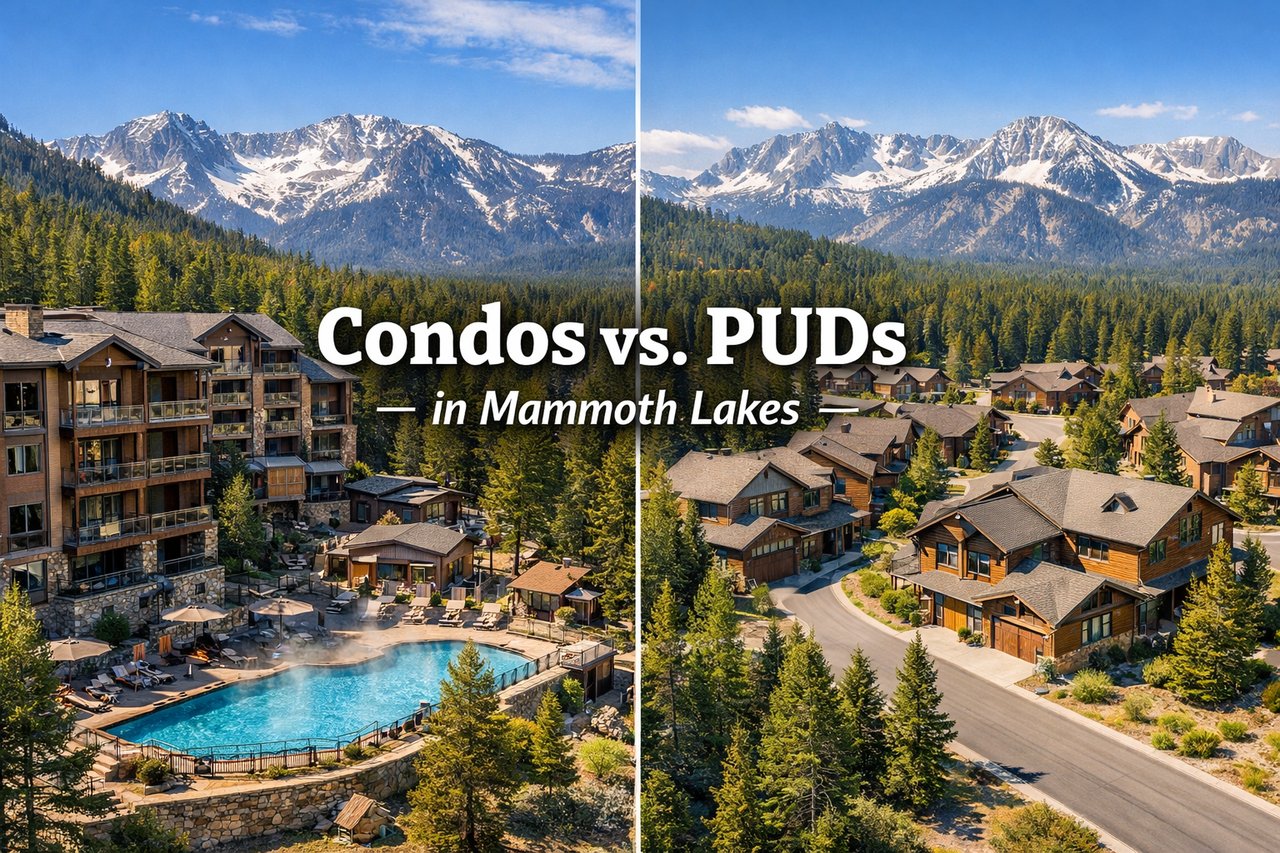
Condos vs. PUDs in Mammoth Lakes
Condo Sonja Bush January 9, 2026
Condo Sonja Bush January 9, 2026
If you’ve ever heard, “It’s basically a condo, but it’s a PUD,” you’re not alone. In Mammoth Lakes, two properties can look very similar (attached, shared walls, HOA dues) but be treated differently by lenders and by the HOA’s maintenance rules. The difference usually comes down to legal ownership, not how the building feels day-to-day.
Below is a practical breakdown focused on financing and owner vs. HOA responsibility.
You typically own the interior “air space” of your unit.
You share ownership (through the HOA) of common areas: roofs, exterior walls, structural components, hallways, stairs, etc.
Lenders often treat condos as a project-based risk, meaning they evaluate the HOA/project as part of underwriting. (Fannie Mae and Freddie Mac both publish detailed condo project standards.) (Fannie Mae Selling Guide)
You typically own your unit AND the underlying lot/parcel (even if it’s a small footprint), plus shared rights in common areas.
HOA membership/dues are mandatory, and the HOA owns/maintains defined common property. (Fannie Mae Selling Guide)
In California, PUDs are commonly referred to as a “planned development” under the Davis-Stirling framework. (Davis-Stirling)
Key point: A property can look like a condo (attached townhome style) and still be a PUD legally.
For many conventional loans, the lender isn’t only approving you—they’re also checking whether the condo project meets eligibility guidelines (budget, reserves, insurance, litigation, owner-occupancy, delinquent dues, etc.). Fannie Mae’s project standards explicitly treat condo and PUD projects differently and require the lender to determine project eligibility. (Fannie Mae Selling Guide)
Why this matters in real life:
If a condo complex has an issue (insurance gaps, too many rentals, pending litigation, deferred maintenance, etc.), a buyer may be limited to certain lenders/loan types—or need different terms.
PUDs still have HOA requirements, but underwriting is often closer to a single-family style review—especially when the project is not treated as a full condo-style project review.
Also, for FHA-related workflows, HUD maintains PUD identifiers/records for case number assignment, separate from condo project approval processes. (ENTP HUD)
In lending/appraisal land, it’s possible for a condo unit to be located within a broader PUD-style development depending on how the community is structured and legally described—this is one reason lenders and appraisers pay close attention to the legal description and project type. (Default)
Bottom line: If financing flexibility is a priority, the condo vs. PUD label can change which loan options are easiest.
This is where buyers are often surprised—because the HOA dues don’t always tell you what the HOA actually maintains.
Common patterns:
Roof
Exterior siding/paint
Structural components
Common plumbing/electrical lines (varies)
Snow removal in common areas
Exterior insurance for the building (often a master policy)
Common patterns:
Owner maintains roof/exterior and under structure (or portions of it), depending on CC&Rs
HOA focuses on roads, parking, landscaping, some common facilities
California HOAs often classify items like patios/balconies or other limited-use areas as “exclusive use common area,” which can affect who repairs and who pays. Davis-Stirling resources discuss how these categories work and why the governing docs matter. (Davis-Stirling)
Best practice: Don’t guess based on dues or appearances. Always verify in:
CC&Rs
HOA maintenance matrix (if available)
Insurance summary (what the master policy covers vs. the unit owner policy)
A few common reasons you’ll see different structures around town:
How the community was originally subdivided and titled
Some were created as condominium projects (unit-based ownership), while others were created as separate interests/lots with an HOA (PUD/planned development). In California, “planned development” is a defined category distinct from condominiums. (Davis-Stirling)
Maintenance and insurance design
Developers sometimes choose a condo structure when they want the HOA to handle more building-level maintenance and insurance. Others prefer a PUD structure when they want owners to have more direct responsibility, with the HOA focused on common amenities.
Lender and market preferences over time
Over the years, financing rules and investor appetites have shifted. Some developers and HOAs have tried to align structures with what they believed would sell best or finance most smoothly at the time (though that doesn’t guarantee easier financing today).
Local building form doesn’t equal legal form
“Townhome style” does not automatically mean PUD, and “stacked units” does not automatically mean condo—but those are common trends.
If you’re buying or selling in Mammoth and the property has an HOA, here’s the clean checklist that prevents surprises:
Confirm the legal type (Condo vs. PUD) on the preliminary title report and/or legal description. Don't rely on what you see online as many agents do not verify prior to listing.
Ask the lender early: “Do you require a condo project review for this address?”
Review HOA docs with two questions in mind:
Who maintains what (roof, siding, decks, under structure, windows)?
What insurance is carried by the HOA vs. the owner?
Get clarity on rental rules (not because of preference—because some financing programs care).
Condos and PUDs both have real benefits in Mammoth Lakes—it’s not about “good vs. bad.” It’s about understanding how the property is legally structured so you can plan for loan options and maintenance responsibilities with confidence.

Buyer

Buyer
Buyer
Buyer

Buyers

Lifestyle

Buyer

Buyer

Buyer
You’ve got questions and we can’t wait to answer them.